
The On Think Tanks State of the Sector Report 2025
The On Think Tanks State of the Sector Report 2025 provides an overview of how think tanks worldwide are navigating an increasingly polarised environment, as well as a comprehensive snapshot of the sector’s current state and future prospects. Now in its sixth edition, this year’s report draws on survey responses from 333 think tanks in 102 countries. It also incorporates insights from the On Think Tanks (OTT) Open Think Tank Directory, which covers more than 3,800 organisations worldwide, as well as sense-making discussions with think tankers in OTT’s global community.
OTT Talks Live: State of the Sector 2025 launch webinar
The launch of the On Think Tanks (OTT) State of the Sector Report 2025 set out to do more than present charts. During this OTT Talks Live session, we asked a harder question: how are think tanks actually navigating today’s political, financial and technological headwinds—and what needs to change? We were joined by Camila Ulloa (principal author of the report), Diana Hollmann (GIZ – Knowledge for Transformation, Africa), Christopher Chibwana (Hewlett Foundation – Gender Equity and Governance), and Enrique Mendizabal (founder of OTT) to unpack the findings and, crucially, to hear what leading funders make of them.
Key highlights
Explore the 10 main findings presented in this report, structured around four thematic sections as shown below:
OPERATING ENVIRONMENT
1. Optimism about sector growth is declining, particularly among think tanks in wealthier democracies and those with larger budgets. Conversely, organisations in lower-income countries and those operating in closed-autocratic regimes report higher growth expectations.
2. Political polarisation is a rising challenge, with 36% of think tanks in 2025 reporting that it affects them to a strong degree (up from 24% in 2024), impacting audience engagement, collaborations with experts, funding options, and media access. However, in ecosystems where research evidence is highly valued, think tanks are better able to navigate political divides – and in turn are less impacted by the challenges of polarisation.
3. Policy impact is stronger in electoral democracies and electoral autocracies than in liberal democracies or closed autocracies. Environments with a receptive media also foster higher levels of policy influence compared to those where the media is less engaged.
4. Think tank agendas largely align with public concerns on economic issues, but key gaps exist in some regions.
FUNDING AND SUSTAINABILITY
5. Core funding is more common in higher-income countries. It is highly sought after – but it is not a panacea. It is not a guarantee of institutional growth or strategic stability, nor does it significantly ease the persistent challenge of covering indirect costs for most organisations.
6. Domestic funding is not inherently more effective than international funding in helping think tanks meet institutional costs; nor do domestically funded organisations necessarily find it easier to secure new funders.
INTERNAL DYNAMICS
7. Salary structures reveal unequal returns. Leadership salaries are higher in think tanks that receive core funding, and significantly increase commensurate with an organisation’s overall turnover. Entry-level pay, however, remains consistent despite these variables, and across all subregions.
8. Capacity gaps are connected to organisational structure, not size. Think tanks lacking dedicated internal units for human resources or finance consistently report the need for capacity building in these areas. Overall, fundraising was cited as one of the most pressing capacity gaps, regardless of a think tank’s size or funding structure.
INNOVATION AND INCLUSION
9. AI use has significantly increased, with 71% of think tanks using AI tools in 2025 (up from 57% in 2024), primarily for communications and research. However, AI use is driven mainly by contextual, rather than internal organisational, factors; this may explain why a significant geographic digital divide persists—and grows.
10. Diversity, equity, and inclusion (DEI) is unevenly embedded, with a think tank’s location and main funding source (international rather than domestic) being stronger predictors of DEI engagement than its organisational size or turnover. Gender is the most common focus of an organisation’s DEI policy (64%), and implementation is typically concentrated on internal governance and HR practices, with less application to research design or external activities.
Regional perspectives
For this edition, we partnered with 25 organisations from different regions of the world. These partners were instrumental in shaping the 2025 report, as they helped with the pilot survey, expanded the survey’s reach through their networks, increasing both the sample size and the breadth of representation, and analysed survey data from their respective national and regional perspectives.
Our partners
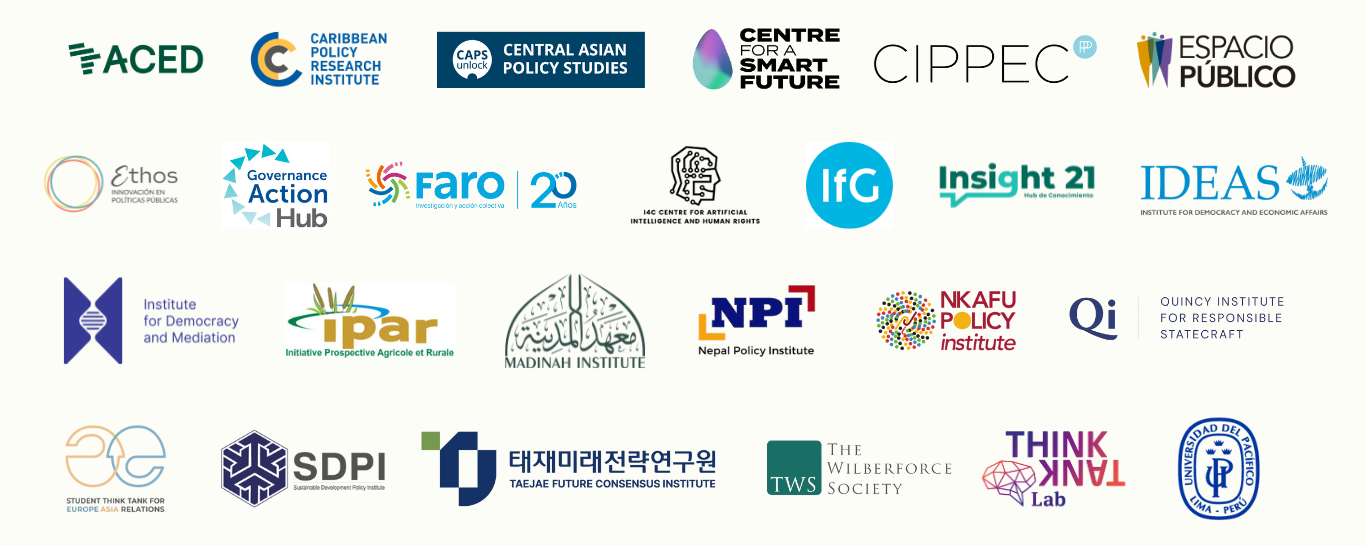
ACED (Benin), CAPRI (Jamaica), CAPS Unlock (Kazakhstan), Centre for a Smart Future / Colombo Urban Lab (Sri Lanka), Centro de Investigación de la Universidad del Pacífico (Peru), CIPPEC (Argentina), Espacio Público (Chile), Ethos (Mexico), Grupo FARO (Ecuador), IDEAS Malaysia (Malaysia), IDM Albania (Albania), Innovation Center for Artificial Intelligence and Human Rights (Pakistan), Insight 21, Universidad Siglo XXI (Argentina), Institute for Government (UK), IPAR (Senegal), Madinah Institute (Saudi Arabia), Nepal Policy Institute (Nepal), Nkafu Policy Institute (Cameroon), Quincy Institute (USA), Results for Development / Governance Action Hub (USA), SDPI (Pakistan), STEAR (Belgium), Taejae Future Consensus Institute (South Korea), The Wilberforce Society (UK), Think Tank Lab (Germany)
Additionally, 19 of our partner organisations produced insightful blogs and short reports based on our findings, contributing critical and fascinating local context to this global data. Explore them below.
The Open Think Tank Directory
On Think Tanks set up the Open Think Tank Directory in 2016 to respond to the lack of publicly available information on think tanks and other policy research centres worldwide. Today, it features public information on more than 3,800 organisations from around the world.
The directory supports the sector’s transparency and enables think tanks and those in the evidence-informed policy world to find and connect. Think tanks can use it to identify potential partners and funders, who can, in turn, identify potential grantees. Additionally, it provides a valuable resource for those who study think tanks.
Want to add your organisation to the directory? Register here.
Join the conversation
At OTT, we believe in the power of evidence-informed dialogue to strengthen think tanks communities. We invite you to organise a discussion using findings from the Report. Please get in touch if you would like our help.
If you are a think tank funder and would like a private briefing of the report and its findings, please contact us.