

 Previous

Many interventions to increase research impact have received a lot of attention recently, including:
- Liberating research from PDFs;
- Changing the writing style from one that is targeted solely at researchers to other audiences;
- Using a variety of techniques to make a research output more engaging, using tools such as Atavist.
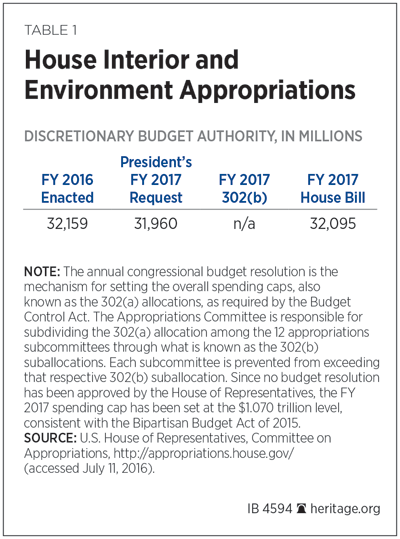
But I would argue that we still look at presenting research in far too static a manner, and in fact where we are more concerned about admiring our own handiwork than truly thinking about research more dynamically.Heritage Foundation example (taken from their Issue Brief 4594) below — if this table is separated from the article then someone could still find the full research report (in this example note the “IB 4594 heritage.org” at the bottom of the table — the table user could find the article by searching on “IB 4594” on the Heritage site).
Take the long view
We spend too much time optimizing each particular research output instead of getting the structures in place to support all our research for the long term.
Fashion is fickle. The deeper we customize a particular article toward what impresses a contemporary audience means the more ridiculous it will look later (just like the more fashionable we are the more ridiculous we look later).
But looks aren’t the real problem. The problem is that the more that we customize for the now means the less likely the research will be useful for long. Research is long term. The particular research output isn’t the first and won’t be the last on the research thread.
This occurs in three ways:
- Over-customization which means that presence-wide changes cannot be rolled out. One problem with over-customization is that if you discover better ways of presenting information they cannot be rolled out to all the existing research. For instance, if you discover that there’s a better way to present data tables but everyone has implemented them in their own way in reports then it can’t be rolled out site-wide.
- Not using templates that allow pertinent newer research to be highlighted. Sometimes your research will be discovered far in the future. There should be ways of linking into newer research.
- Overlooking opportunities to weave a longer-term story. Ideally there are ways of presenting this research within the longer term context, in a dynamic way.
View your research as a launch point
The particular research output should not be considered solely as a destination but as a launch point to more about your research.
This may seem counter-intuitive, but your site visitor may arrive on your beautiful report and it may not be what they are most interested in. After all, the report may happen to be the first content of yours that they have seen, and may arrive somewhat arbitrarily, for instance from a Google search.
Ideally you create your research article to include a rich context that allows the ability to go broader (for instance, to see all the research you have on the topic), laterally (to related research), or deeper (to the raw data or the details on the research methodology). This should all be done dynamically, such that as more research is added the contextual information updates as well (this is particularly relevant for the lateral navigation options).